 About Us
 News
 Store Locator
 Support
Common ST25 Rice Counterfeiting Tricks & How to Spot Them

ST25 Rice has quickly become the top choice of millions of Vietnamese families. However, this very popularity has made ST25 the most counterfeited rice on the market.
Poor-quality rice not only makes consumers “waste their money” but also poses serious health risks due to residues of chemical scents and bleaching agents. In this article, Mê Gạo reveals the 4 most sophisticated tricks used to counterfeit ST25 Rice and shows you how to quickly check real and fake rice at home.
The most sophisticated and common ST25 Rice counterfeiting tricks
Watch out for the following common tricks to avoid buying poor-quality products by mistake.
1. Counterfeiting the packaging of famous brands
Fake packaging is the simplest yet most effective method used by ST25 Rice counterfeiters. Counterfeit operations copy the designs, logos and colors of reputable ST25 Rice brands exactly.
- How it works: Counterfeiters print large quantities of packaging with near-perfect designs (seals, labels, printed text), then fill it with poor-quality (or blended) rice.
- Level of sophistication: Today, even printing details (image sharpness, fonts) are skillfully imitated. Without a genuine package to compare against, telling real from fake by the packaging becomes extremely difficult.
- Solution: Consumers should carefully check security features such as scratch-off seals, electronic authentication barcodes and the thickness/quality of the packaging material.
2. Rice blending
This is the most dangerous and hardest-to-detect form of counterfeiting because the product is not entirely fake. Instead, sellers mix pure ST25 Rice (in very small quantities) with low-grade rice varieties of similar appearance.
- Counterfeiters usually blend in 30 – 50% genuine ST25 rice to retain some of its distinctive aroma and stickiness when cooked. The rest is ordinary rice costing 30-50% less than the standard ST25 Rice price.
- Consumers waste their money by paying a high price for rice with significantly reduced nutritional quality, flavor and safety. Blended rice usually no longer retains the high nutritional value of ST25.
- Early warning sign: A bag of blended rice will have poor uniformity in grain size and translucency.
3. Using chemical flavorings
Its distinctive aroma is ST25 Rice’s biggest competitive advantage. Taking advantage of this, counterfeiters use industrial flavorings to “add scent” to odorless rice or old, moldy rice.
- Poor-quality rice is soaked in or sprayed directly with scenting agents (usually chemicals of unknown origin) to give it an aroma similar to ST25 Rice.
- This is the trick that poses the greatest threat to consumers’ health. Chemical scents may contain toxic substances that accumulate in the body with long-term use, affecting the digestive and respiratory systems.
- Genuine ST25 Rice has a light, natural and subtle aroma. The smell of chemical flavorings is usually too strong and harsh, and it fades quickly once the rice is exposed to the air.
4. Selling at “super-cheap” prices on unregulated online channels
This trick exploits psychological weak spots and distribution channels. Counterfeiters play on customers’ desire to save money by selling ST25 Rice at unusually low prices (below the floor price), mainly through unofficial online sales channels (personal social media accounts, small e-commerce sites).
- Attractive low prices make consumers skip checking quality and origin. Quick online transactions also make it harder to verify the source of the goods.
- These channels usually have no warranty or return policy, and the product’s origin cannot be traced. When buyers discover a counterfeit, they bear the full loss.
- Consumers should never buy ST25 Rice priced 20-30% below the official list price. An unusually low price is always a warning sign about quality.
A simple, reliable guide to telling real ST25 rice from fake
To proactively protect your rights and your family’s health, arm yourself with 4 methods for checking genuine ST25 Rice at home. Mê Gạo offers tips to help you tell real from fake in just a few minutes.
Identifying ST25 Rice by its packaging and labels
Checking the legitimacy and print quality of the packaging is the first and most important step.
| Criteria | 100% Pure ST25 Rice | Fake ST25 Rice (poor quality) |
| Packaging material | Thick and sturdy, with sharp printing and no smudged colors. Text and logo are consistent in font and size. | Thinner, with poor print quality; images and text smudge easily. Small discrepancies in the logo/font may be noticeable. |
| Production information | Transparent information (production date, expiry date, manufacturer/distributor) printed clearly and hard to erase. | Faded printing, signs of alteration, or missing key certifications. |
Check the shape of the grains
After verifying the packaging, open the bag and inspect the grains directly.
Shape and color:
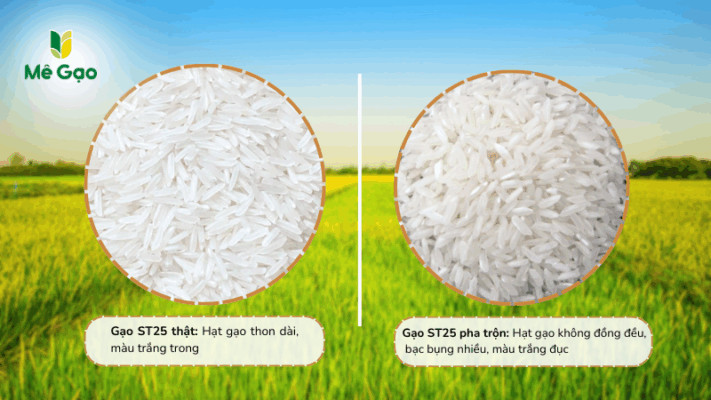
- Genuine ST25 Rice: The grains are long and slender (pure rice variety), crystal-clear translucent white, with a small chalky spot in the middle of the grain. The grain size is very uniform (high purity).
- Fake/blended ST25 rice: The grains are uneven, mixed with grains of different sizes (round, short grains). The color is more opaque or too white (due to bleaching).
Aroma (before cooking):
- Genuine ST25 Rice: Has a natural, gentle and subtle pandan (pandan leaf) aroma. The scent is not harsh.
- Fake/scented rice: A strong, harsh scent that feels chemical due to industrial flavorings. This smell disappears quickly when exposed to the air.
Cleanliness: Genuine ST25 Rice grains are dry, with no fine dust (bran) sticking to your hands.
Identifying it by rinsing/soaking the rice
Before cooking, rinsing the rice is also an effective test for detecting fakes.
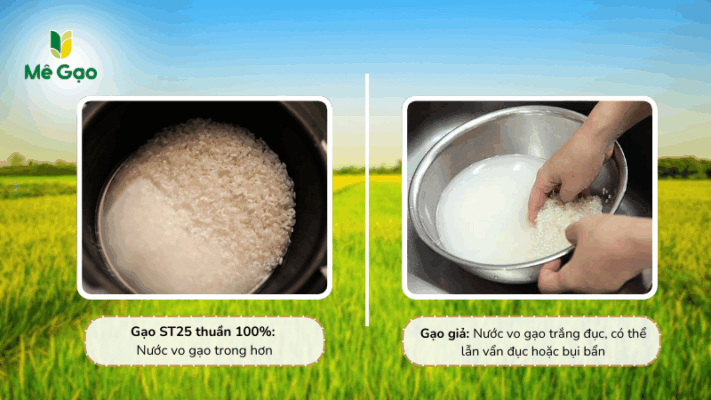
Whiteness of the rinsing water:
- 100% pure ST25 Rice: The rinsing water is clearer than with ordinary rice (because it has been thoroughly milled and has little bran).
- Fake rice: The rinsing water is milky white and may contain cloudy specks or dirt if the rice is old, poor quality or sprayed with chemicals to make it shiny.
Smell when soaking: If you soak the rice for about 15-30 minutes, any chemical smell in fake rice will become noticeably stronger and more unpleasant.
Quality test after cooking
| Criteria | 100% Pure ST25 Rice | Poor-quality, blended ST25 rice |
| Stickiness/cohesion | Soft, sticky, slightly chewy and highly cohesive. The grains stay whole and unbroken. | Dry or crumbly (if old rice). The grains are separate and do not stay sticky after cooling. |
| Aroma | Natural aroma that lasts even after the rice has cooled. | Aroma fades quickly after cooking, or has the odd smell of old rice. |
| Flavor | Mildly sweet and flavorful (due to low amylose content). | Bland, slightly sour or with an unpleasant smell (if old/moldy rice). |
Frequently Asked Questions (FAQ)
1. How can you tell a natural pandan aroma from chemical flavoring?
- Natural aroma: Gentle and subtle; it does not become unpleasant even after smelling it for a while. When cooked, the aroma spreads softly and sweetly and lingers in the rice for a long time.
- Chemical scent: Strong and harsh; when you sniff closely, you feel a pungent sensation in your nose. In particular, after cooking or a short time exposed to the air, this scent disappears completely, leaving the rice odorless or with a strange smell.
2. I bought ST25 Rice, but the cooked rice dries out when cooled. Did I buy a fake by mistake?
Very likely. The most outstanding characteristic of ST25 is that the rice stays soft and tender even when cooled. If the rice turns dry, hard and separate after a few hours, it is most likely old rice, poor-quality rice or rice blended with a high proportion of ordinary rice. However, you should also double-check the amount of water you use (the standard ratio is 1 part rice : 1 part water).
3. Does pure ST25 Rice get weevils?
Yes. Pure ST25 Rice is clean rice with few pesticide residues and preservatives, so it is normal for weevils to appear when it is stored for a long time in natural conditions. In contrast, rice treated with strong chemical preservatives is usually never attacked by weevils but is extremely harmful to human health.
Fake ST25 rice may look similar, but it can never replicate the nutritional value and flavor of the real thing. Always be wary of products with unusually low prices, faded packaging printing and a strong, harsh chemical smell. If you need advice on pure ST25 Rice, call the Mê Gạo hotline today and bring home clean rice for your family with peace of mind.