
 About Us
 News
 Store Locator
 Support
KDM Rice Cultivation Process: A Guide to Crop Care & Fertilization

The KDM (Kow Dak Mali) rice variety offers a premium flavor thanks to the unique soil found only in Cambodia. To produce grains of KDM Rice, farmers must strictly follow an ecological KDM rice cultivation process. With a full 6-month growing period and only 1 crop per year, every stage from land preparation and sowing to fertilizing requires meticulous care.
The article below analyzes each technical step in detail to help the rice plants grow healthy and preserve the original flavor of this rare and prized variety.
About the KDM (Kow Dak Mali) rice variety
Origin and biological characteristics
When looking into the origin of the KDM rice variety, you will find that it is a rare and prized rice line, especially grade 1 KDM Rice, which is grown exclusively in Cambodia. Being planted only in Cambodia’s unique soil regions gives KDM rice a distinctive flavor that no other rice variety can replace.
The rice has a growing period of up to 6 months.
Outstanding characteristics of KDM Rice:
- The grains are large, long, plump, slightly curved and attractively translucent white.
- The rice has a gentle, natural pandan-like aroma that is released as soon as it is cooked.
- When cooked, the rice is soft and tender, expands little and, notably, stays delicious even when cooled.
- The rice has a natural mild sweetness, and the grains are always firm and plump.
With these outstanding qualities, the product easily wins over diners with the highest expectations for both quality and a unique culinary experience.
Environmental requirements (soil, climate, water)
KDM rice grows vigorously and reaches its best quality thanks to the unique soil and climate of its growing region. The plants require a clean, stable irrigation water supply and alluvium-rich soil to grow steadily throughout their long life cycle.
Preparation before sowing
Setting the planting calendar
Unlike ordinary short-duration rice varieties, KDM rice requires meticulous care and is sown only 1 crop per year. The planting calendar must be carefully calculated to ensure the plants have the best conditions to grow before harvesting after 6 months.
Land preparation and field sanitation
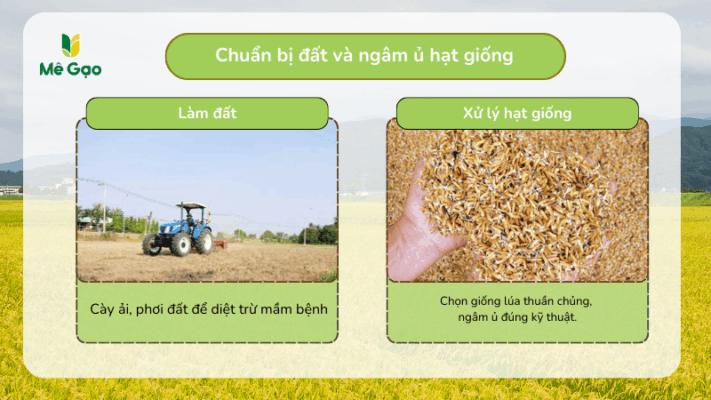
Before sowing, the fields need to be plowed and left to dry in the sun to kill pathogens. Leveling the field surface and clearing weeds and plant residue from the previous crop are mandatory steps to create a clean growing environment and minimize the spread of fungal diseases.
Selecting and treating KDM seeds
To ensure quality, the seeds must be from a premium purebred rice variety. The packaging process ensures that no other rice is blended into the same bag, preserving the original flavor of KDM rice. The seeds need to be soaked and incubated correctly so they germinate evenly.
Sowing techniques and standard density
Broadcast sowing vs. row sowing
For KDM rice, row sowing is recommended over broadcast sowing. Row sowing gives the plants room for better photosynthesis and deeper roots, while making it easier for farmers to control weeds and off-type rice plants during crop care.
Recommended sowing density to reduce lodging
Because its growing period lasts up to 6 months, the KDM rice plant develops quite vigorous stems and leaves. Sowing density should be kept reasonably sparse (about 80 – 100 kg/ha depending on the method). Sparse sowing makes the stems sturdier, increases resistance to wind and storms and reduces lodging at the end of the season.
Crop care and fertilization process for KDM rice
Water management at each growth stage
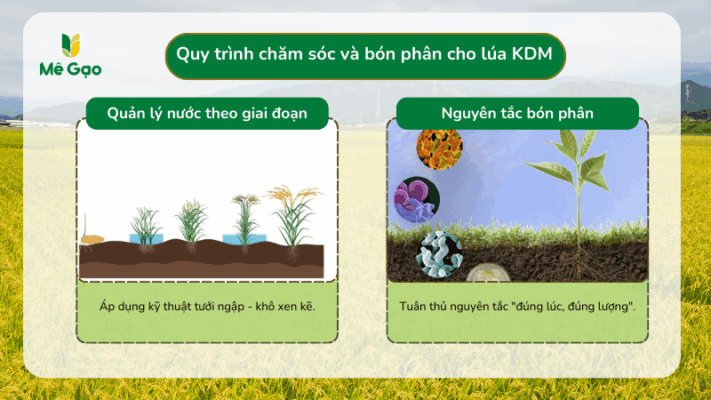
Apply the alternate wetting and drying technique. During the tillering stage, maintain a shallow water level so the plants produce plenty of tillers. From panicle initiation to heading, supply enough water so the grains do not become empty. 10-15 days before harvest, drain the water completely so the field surface is dry.
Balanced fertilization process
Fertilization should follow the principle of “the right time, the right amount”. Divide it into basal fertilization, top-dressing for tillering and top-dressing for panicle initiation. Avoid overusing nitrogen fertilizer at the end of the season to prevent pests and diseases and avoid reducing grain quality.
Using organic/microbial fertilizers to improve rice quality
To bring peace of mind and satisfaction to every family meal under the “Delicious – Clean – Preservative-free” criteria, using organic fertilizers is extremely important.
Production needs to follow a sustainable process. As a result, Mê Gạo products can achieve reputable international certifications such as FDA and HALAL, as well as standards such as HACCP and ISO 22000:2018, delivering the most delicious, high-quality meals.
Controlling common pests and diseases on KDM rice
Managing weeds early in the season
Use thorough land preparation and maintain a suitable water level from the start of the season to suppress weeds. If herbicides are used, prioritize safe biological products and comply with pesticide residue standards.
Controlling brown planthoppers and leaf folders
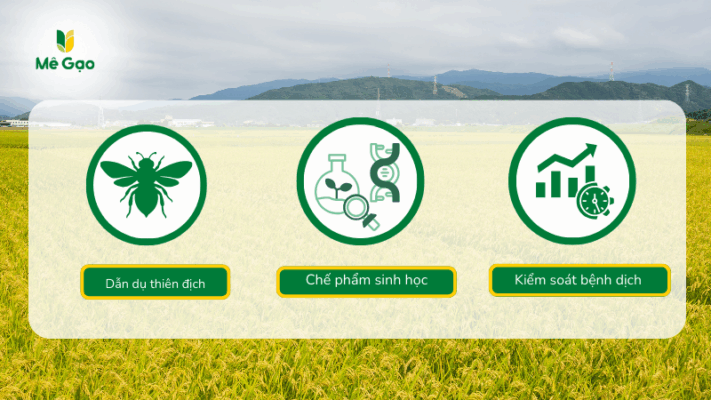
Visit the fields regularly to detect brown planthopper colonies and leaf folder damage early. Use natural predators or spray targeted pesticides when pest density exceeds the safe threshold.
Controlling rice blast and leaf blight
Rice blast often appears in foggy weather with high humidity. Fertilize in a balanced way and avoid excess nitrogen. Spray suitable biological products for prevention and control as soon as lesions start to appear on the leaves.
Harvesting and post-harvest storage
Determining when to harvest
KDM rice is harvested only after exactly 6 months of growth. The ideal time to harvest is when about 85-90% of the grains on the panicle have turned golden; at this point the grains are firm and plump and retain their rich natural flavor.
Drying techniques to keep grains unbroken and preserve their aroma
Right after harvesting, the rice needs to go into a dryer with strictly controlled temperatures. Drying slowly helps the grains keep their large, long, plump shape, prevents cracking and breaking during milling and, most importantly, locks in the natural pandan aroma inside. Only this standard process can uphold the principle of using a single rice variety, delivering an unblended flavor.
Frequently Asked Questions (FAQ)
Can KDM rice be grown 2 crops per year?
No. The KDM rice variety requires meticulous cultivation and is sown only 1 crop per year. Thanks to its growing period of up to 6 months, the grains can accumulate enough nutrients to produce tender, fragrant rice with a rich natural flavor.
Why do KDM rice crops produce empty grains?
Empty grains are usually caused by adverse weather (storms, strong winds) during the heading and flowering stage, or by poor nutrient and water management that leaves the plants without enough strength to fill the grains. Following a sustainable crop care process correctly will solve this problem.





