
 About Us
 News
 Store Locator
 Support
How to Make Simple, Authentic Fermented Sticky Rice with Glutinous Rice

Fermented glutinous rice (com ruou) is not only a traditional dish full of homeland flavor but also contains many vitamins and minerals that are good for the digestive system. To make a perfectly fermented batch, choosing the right ingredients plays a decisive role. With Glutinous Rice, fermented sticky rice turns out tender, fragrant like pandan leaf, and the grains stay intact after fermenting.
With the guide to making fermented sticky rice from Glutinous Rice that Mê Gạo shares below, you can easily make naturally sweet fermented sticky rice yourself at home.
Why choose Glutinous Rice for fermented sticky rice?
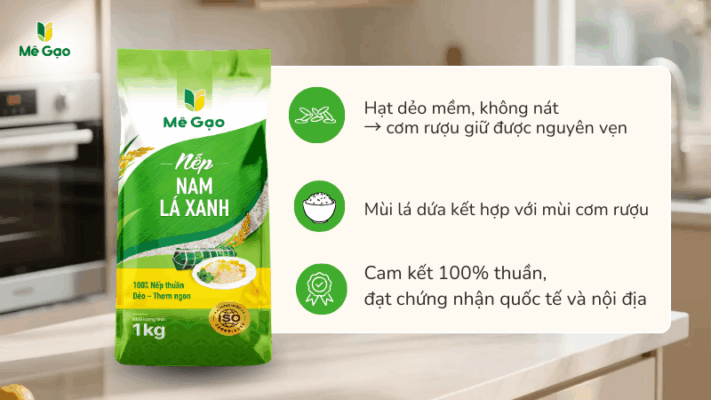
Glutinous Rice is ideal for fermented sticky rice thanks to its consistent stickiness, natural pandan aroma and ability to ferment into a mild sweetness without the grains breaking down.
These outstanding characteristics of Glutinous Rice set it apart from ordinary glutinous rice:
- Just the right stickiness, grains stay intact after fermenting: Nam La Xanh grains are sticky but not mushy, so the fermented rice keeps the shape of each grain and offers a noticeably pleasant texture.
- Natural pandan aroma: Glutinous Rice has a gentle fragrance like pandan leaf; combined with the yeast, it creates a distinctive aroma that is easy to recognize and more appealing than ordinary glutinous rice.
- Consistent fermentation – natural mild sweetness: Thanks to its uniform grain quality, Glutinous Rice ferments evenly, producing a mild sweetness (not harsh, not sour) and minimizing the risk of bitter or pungent fermented rice.
- Pure glutinous rice, no blending: Nam La Xanh is 100% pure glutinous rice, never mixed with low-quality glutinous rice, preserving the full traditional flavor of fermented glutinous rice.
- Glutinous Rice is produced using a modern process and holds reputable certifications such as FDA, HACCP, HALAL and ISO 22000, ensuring hygiene and safety for consumers.
Prepare the ingredients
For a perfect batch of fermented sticky rice, you will need the following:
- Glutinous rice: 1 kg Glutinous Rice.
- Yeast: 3 sweet yeast balls (or 4 if you are making it in winter). Choose handmade yeast made from rice flour, with round, white balls and the distinctive scent of traditional herbs; never use moldy yeast.
- Tools: Fresh banana leaves (or lotus leaves), a plastic basket, a pot for fermenting and a flat tray or rack.
How to make fermented sticky rice with Glutinous Rice
Making fermented sticky rice with Glutinous Rice involves 4 steps: soaking and cooking the glutinous rice, cooling it, preparing the yeast and fermenting it properly for a mild sweetness, tender and fragrant grains and consistent fermentation.
Step 1: Rinse and cook the glutinous rice
- First, rinse and soak the glutinous rice for 4 – 6 hours. Soaking helps the grains expand evenly and cook faster. Pick out any husks and damaged grains that float.
- After soaking, drain the glutinous rice.
- You can cook it in a rice cooker or steam it. If steaming, place the glutinous rice in a steamer until cooked; the grains will be tender and fragrant, not mushy.
Step 2: Fluff and cool
- Wash the banana leaves and wipe them completely dry. Spread the banana leaves on a flat surface (a large tray or platter).
- Spread the cooked glutinous rice evenly on the banana leaves in a thin layer so it cools quickly.
- Note: Let the rice cool until it is just warm to the touch (about 30 – 35 degrees C). Never sprinkle the yeast on while the rice is still hot, because high temperatures will kill the microorganisms in the yeast.
Step 3: Prepare the yeast
- While waiting for the Nam La Xanh sticky rice to cool, grind the 3 yeast balls into a fine powder with a mortar and pestle.
- Sift the yeast powder through a fine sieve to remove husks and large bits, so the batch turns out smooth and the yeast coats every grain evenly.
Step 4: Sprinkle the yeast and ferment
- Divide the fine yeast powder into 2 portions.
- Sift the first portion evenly over the surface of the glutinous rice. Gently mix with your hands (or a clean spoon).
- Sift the remaining yeast over the rice and mix a second time to make sure every grain is coated with yeast.
- Line a basket or pot with banana leaves. Add the yeast-coated glutinous rice and wrap the banana leaves tightly around it. Place the basket on top of an upside-down bowl inside a large pot (making sure the basket does not touch the bottom of the pot so the rice wine liquid can drain below). Wrap the pot in a thick cloth to keep it warm.
How long should fermented sticky rice ferment?
Fermentation time depends mainly on the ambient temperature; on average, 3-7 days is enough to reach the right mild sweetness and aroma.
- Summer: Just 3 – 4 days of tightly covered fermentation is enough. By then, the rice has fermented well, the grains look slightly glossy, rice wine liquid has formed and the distinctive aroma has developed.
- Winter: Fermentation takes longer, about 5-7 days, because the yeast works more slowly.
Frequently Asked Questions (FAQ)
Why does my fermented sticky rice taste very bitter?
Bitter fermented sticky rice usually has 3 main causes:
- Poor-quality yeast: Using moldy or substandard yeast, or too much yeast for the amount of glutinous rice.
- Sprinkling yeast while the rice is still hot: This kills the beneficial microorganisms and allows harmful bacteria to grow, causing a harsh sour and bitter taste.
- Fermenting too long: Fermenting beyond the right time pushes the process past the sugar-forming stage and straight into alcohol and vinegar.
How long does fermented Nam La Xanh sticky rice keep?
After 3-4 days of fermentation, once the rice has reached the right sweetness, transfer both the rice and the liquid to a tightly sealed glass container and store it in the refrigerator. The cold slows down fermentation. This way, it will stay delicious for about 5 – 7 days.





