
 About Us
 News
 Store Locator
 Support
How to Wrap Banh Tet with Glutinous Rice: Soft, Tender and Beautiful

Cylindrical sticky rice cake (banh tet) is an essential dish during the traditional Vietnamese Lunar New Year (Tet). With its long, perfectly uniform grains, ideal soft and tender texture and natural pandan aroma, Mê Gạo Glutinous Rice meets every standard for making a banh tet roll that looks beautiful and tastes authentically tender and fragrant.
In the article below, Mê Gạo gives a detailed guide to wrapping banh tet with Glutinous Rice so you can confidently make it at home.
Why choose Glutinous Rice for banh tet?
Glutinous Rice is chosen for banh tet because of its long grains, consistent stickiness, natural pandan aroma and beautiful color. Thanks to its pure quality and good cohesion, banh tet holds a firm shape after boiling, is neither mushy nor undercooked, and has an authentic traditional flavor.
- Long, uniform grains keep banh tet firm: Glutinous Rice has long grains of uniform size, so the rice layer hugs the mung bean and pork belly filling closely and keeps the roll nicely round. When cut, the surface is smooth, without holes or crumbling, giving the banh tet a beautiful, professional look.
- Consistent stickiness after hours of boiling: Throughout 8 – 10 hours of boiling, the rice still expands evenly without bursting, does not turn mushy and does not dry out when cooled, giving banh tet the perfect soft and tender texture.
- Distinctive natural pandan aroma: Glutinous Rice naturally has a light pandan fragrance, with no need for added flavoring. As it boils, the aroma spreads naturally, preserving a traditional, light and pleasant taste.
- Beautiful natural green color: When combined with pandan leaf juice or katuk leaf juice, the rice absorbs the green color very well and evenly, without blotches, giving banh tet an appealing green color without food coloring.
- Pure glutinous rice that meets international standards: The product holds certifications such as FDA, HALAL, HACCP and ISO 22000:2018, contains no preservatives, is safe for health and suitable for the whole family during Tet.
Prepare the ingredients
To wrap about 4 banh tet rolls (1 kg/roll), prepare the following ingredients:
| Ingredient | Amount | Notes |
| Glutinous Rice (Mê Gạo) | 1 kg | Rinse and drain |
| Hulled split mung beans | 400 g | Plump, bright yellow beans |
| Pork belly | 400 g | Choose pieces with fat and lean meat attached |
| Banana leaves | 1 – 1.5 kg | Sun-wilt or blanch in boiling water |
| Bamboo strings | 1 bundle | Soak in water until soft and pliable |
| Seasonings | As needed | Salt, pepper, sugar, minced shallots |
| Natural coloring juice | 1 bowl | Pandan leaf juice or blended katuk leaves |
Preparation for natural color and authentic flavor
Proper preparation helps Glutinous Rice reach the right stickiness, take on a natural green color and keep a perfect texture when wrapping banh tet.
The secret to soaking: How long to soak Glutinous Rice
For Glutinous Rice to be as tender and fragrant as possible without broken grains, follow these steps:
- Rinse the rice: Rinse gently with clean water to remove dust.
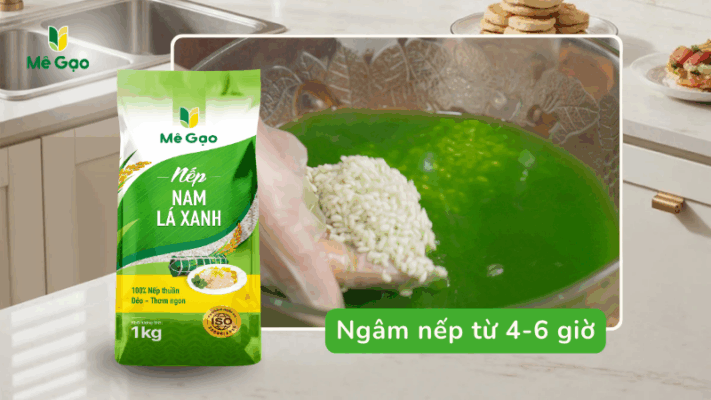
- Soak the rice: Unlike ordinary glutinous rice, Glutinous Rice only needs to be soaked for about 4 – 6 hours. Do not soak it too long, or the rice may turn sour.
- Add color: The grains already have a natural pandan aroma, so you only need to apply a natural coloring method by mixing katuk leaf (or pandan leaf) juice into the rice during the last hour of soaking to give the outer layer of the cake a beautiful green color.
- Season: Drain the rice. Toss it evenly with 1 tablespoon of salt to give the outer layer of the cake a rich flavor.
Preparing the mung bean and pork filling
- Mung beans: Soak in water for 4 hours until soft, steam until cooked, mash finely and season with a little salt.
- Pork belly: Cut the pork into long strips the same length as the roll. Marinate with shallots, pepper, salt and 1 tablespoon of sugar.
Simple, detailed guide to wrapping banh tet at home
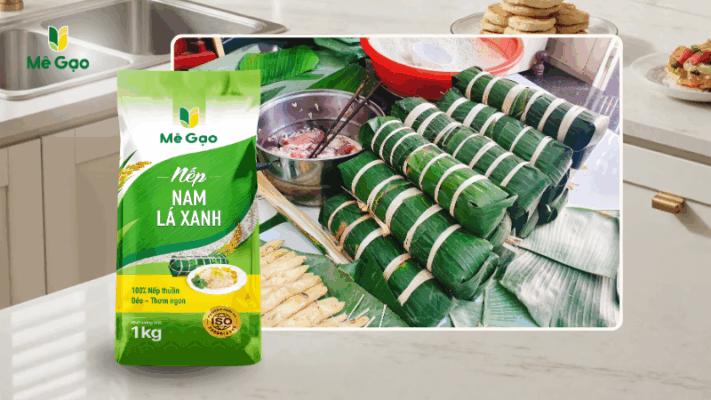
- Step 1: Lay 2 large banana leaves lengthwise, overlapping (shiny side down). Then lay 2 smaller banana leaves crosswise on top (shiny side up) so they touch the rice directly.
- Step 2: Spread 1 bowl of Glutinous Rice evenly on the leaves in a rectangle. Place the mung bean filling, wrapped completely around the pork belly strip, in the middle of the rice layer. Add more rice to cover the mung bean filling completely.
- Step 3: Fold the two long edges of the leaves together, roll it up and squeeze tightly so the rice hugs the filling. Tie a string temporarily around the middle of the roll to hold its shape.
- Step 4: Fold down one end of the leaves and stand the roll upright. Gently poke with chopsticks so the rice packs down tightly. Trim the excess leaves and fold the edges into a neat square. Cover the end of the cake with 2 small pieces of banana leaf crossed over each other and tie them in place with string. Turn the cake over and repeat with the other end.
- Step 5: Tie strings lengthwise and crosswise around the body of the cake (about 6-8 times). Tie them firmly but not so tightly that the leaves split when the rice expands.
How to boil and remove the cakes properly
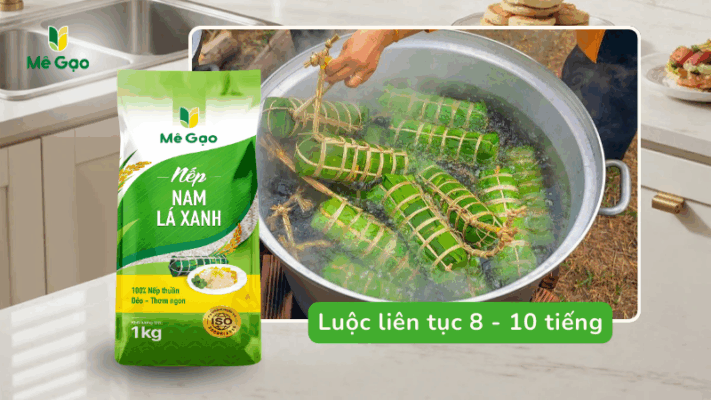
- Arrange the cakes: Line the bottom of the pot with scraps of banana leaves. Stand the banh tet upright, packed snugly together.
- Add water: Pour in water to cover the cakes. Bring to a boil over high heat.
- Boiling time: Boil continuously for 8 – 10 hours.
- Tip: When the water level drops, always top it up with boiling water (do not use cold water, or the cakes will be undercooked).
- Remove the cakes: Once cooked, remove the cakes and immediately soak them in a basin of cold water for about 15 minutes. Hang the cakes in a cool, airy place to drain.
Common mistakes to watch out for when wrapping banh tet
- Undercooked or raw cakes: This is usually caused by soaking the rice for less than 4 hours, adding cold water during boiling, or not keeping the cakes fully submerged. To avoid this, soak the rice for the standard 4 to 6 hours, only add boiling water to the pot and place a heavy object on top so the cakes stay completely underwater.
- Pale cakes: The main causes are placing the banana leaves on the wrong side or making the coloring juice too diluted. You can easily fix this by making sure the shiny side (the dark green side) of the banana leaf touches the rice directly and using concentrated leaf juice for coloring.
- Loose strings or broken cakes: This happens when the strings are tied too loosely or the cakes are boiled over heat that is too high, so the vigorously bubbling water knocks the rolls out of shape. The best solution is to tie the strings firmly enough to keep some flexibility and maintain a steady flame as soon as the water in the pot comes to a full boil.
Frequently Asked Questions (FAQ)
Do you need to press banh tet after boiling?
Yes, banh tet should be pressed after boiling to keep it firm and prevent mushiness. After removing the cakes, soak them in cold water for about 10 – 15 minutes, then hang them up to drain. This helps the cakes hold their shape better, keeps them from breaking when cut and gives them a firm, tender texture.
Do you need to stir-fry the glutinous rice with coconut milk before wrapping?
That depends on regional taste. If you are making southwestern Vietnam-style banh tet, stir-frying the rice with coconut milk, a little salt and sugar in a pan (about 15-20 minutes until the rice absorbs some of the liquid) is essential for a rich, creamy flavor.





