
 About Us
 News
 Store Locator
 Support
Why Is ST25 Rice So Expensive? The Rice Renowned for Its Flavor

Why is ST25 Rice so expensive compared with many other types of rice on the market? ST25 Rice costs more than average because it is a rare specialty rice variety grown under a strict process.
Mê Gạo breaks down each factor behind the “premium” value of ST25 Rice, helping you understand why, at that price, ST25 Rice truly deserves to be your top choice for health and an exceptional dining experience.
The distinctive quality and flavor of ST25 Rice
The core value that wins consumers over to ST25 Rice lies in its distinctive taste experience. It is the result of more than 20 years of persistent research and breeding by Engineer Ho Quang Cua and his colleagues to create a premium fragrant rice variety in Soc Trang.
Signs of quality:
- Grain shape: The grains are long, slender, translucent white, uniform and completely free of chalkiness.
- Natural aroma: Even as raw rice, ST25 gives off a gentle fragrance. When cooked, your kitchen fills with the aroma of pandan blended with young green-rice flakes (com).
- Perfect texture: The cooked grains are dry, whole and moderately sticky and cohesive rather than mushy.
- Stickiness: The biggest plus of ST25 is its ability to stay soft and tender even when cooled. The rice never dries out, hardens or clumps, something few types of rice can do.
- Sweet aftertaste: The rice has a mild sweetness that stimulates the taste buds and makes everyday meals more delicious.
It is this superior quality that has positioned ST25 in the premium segment, making it a top choice for family meals.
ST25 Rice – Delicious, quality rice
Not only is it loved in Vietnam, but ST25 Rice has also firmly established its position on the global rice map. When a product is sought after and recognized worldwide, it is entirely understandable that it costs more than average; that is the value of a quality product.
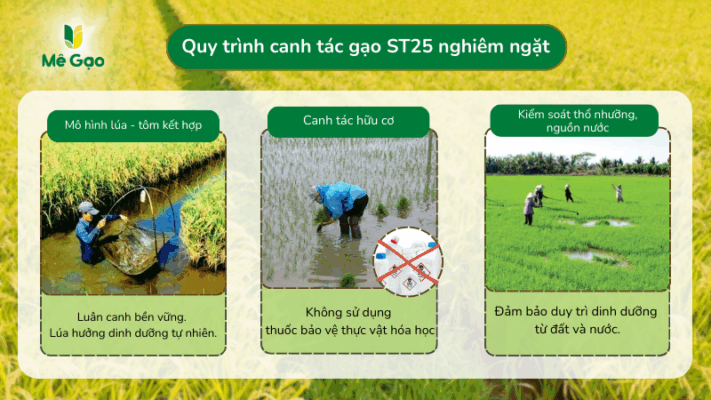
The “clean” and strict farming process of ST25 Rice
To produce high-quality grains, the ST25 Rice farming process goes beyond advanced techniques to include compliance with strict standards.
- Rice–shrimp model: This is a famous sustainable farming model in Soc Trang. Rice is grown in rotation on shrimp-farming land. As a result, the rice plants benefit from natural nutrients from shrimp waste, minimizing the use of chemical fertilizers and pesticides (since pesticides would kill the shrimp).
- Organic farming: Many ST25 growing areas are farmed to strict organic standards (such as USDA, EU, VietGAP) without any agricultural chemicals.
- Soil selection: ST25 was developed to suit the land of Soc Trang (saline, alum-affected soil), but to achieve the highest quality, controlling the water source and soil is extremely important.
This “clean” farming process requires a lot of effort, advanced techniques and risk-taking, resulting in much higher production costs than conventional intensive farming.
Lower yields than high-yield rice varieties
A common misconception is that ST25 Rice is both delicious and high-yielding. However, compared with high-yield rice varieties (such as IR varieties) used for industrial production, ST25 clearly focuses on quality rather than quantity.
- High-yield rice varieties (such as IR504, Ham Chau…) are created mainly for output. They can yield 8-10 tons/ha.
- ST25 Rice is a fragrant rice variety created mainly for quality. ST25 is a photoperiod-sensitive variety (dependent on light) with a longer growing period (about 105-115 days). In particular, in the ideal rice–shrimp model, farmers can grow only one ST25 crop per year, and ST25 yields usually stay at just 5-6 tons/ha, significantly lower.
With scarce supply and very high demand in both the domestic and export markets, the basic law of supply and demand pushes the price of ST25 much higher than that of mass-produced rice.
Brand value and “National Pride”
When you buy a bag of ST25 Rice, you are not just paying for the rice. You are paying for:
- More than 20 years of research, breeding and countless failed trials by Engineer Ho Quang Cua and his team. This is an invisible but priceless “brainpower” cost.
- Brand value: ST25 Rice has become a national brand, a “pride” of Vietnamese agriculture. Just as the Japanese are proud of Koshihikari rice, Vietnamese people now have ST25 Rice.
- The story of an engineer who devoted his whole life to rice has given the product its appeal and value.
Brand protection and anti-counterfeiting costs
Fame always comes with a painful problem: counterfeits and imitations. To protect the reputation of Vietnamese rice and customers’ interests, producers have invested heavily in:
- Anti-counterfeit packaging technology: Investing in modern vacuum packaging lines and using complex, hard-to-copy packaging to prevent counterfeiting and content swapping.
- Transparent origin: Adding anti-counterfeit stamps (QR codes) that identify each bag of rice. With a single scan, you can trace its origin, packing date and production batch in detail.
- Global brand protection: Registering intellectual property not only in Vietnam but also in demanding markets (the US, Australia, the EU…). This ensures ST25’s reputation is protected under international law.
- Consumer education: Continuously sharing the signs of real and fake products so consumers don’t “waste their money”.
Genuine ST25 may cost a little more, but that is a necessary “insurance premium”. When you buy the genuine product, you get not only delicious rice but also commitment and complete peace of mind.
Frequently Asked Questions (FAQ)
Is ST25 Rice really more delicious than Thai rice?
In terms of sensory qualities, ST25 is highly rated for its soft, tender texture, grains that don’t stick together and stay soft even when cooled, and its gentle pandan aroma, while many Thai rice varieties (depending on the variety) can be harder when cooled.
Is ST25 Rice sticky or dry?
ST25 Rice is a soft, sticky rice. When cooked, the grains are very soft and highly tender yet still fluffy, not soggy and not gummy (mushy). In particular, cooked ST25 Rice stays soft and tender when cooled without drying out and hardening like ordinary rice.
Is ST25 Rice glutinous or non-glutinous?
ST25 Rice is a non-glutinous rice (indica rice) used for everyday cooked rice at main meals. Although it is very tender and has a distinctive aroma, it is not glutinous rice, which is used for sticky rice (xoi), square sticky rice cake (banh chung) and other traditional cakes.
The price of ST25 fully reflects an ecosystem of quality, from the rice variety to clean, strict farming. To make sure you receive quality pure ST25 Rice, contact Mê Gạo now via our hotline 0973 978 039 for advice and to place an order





